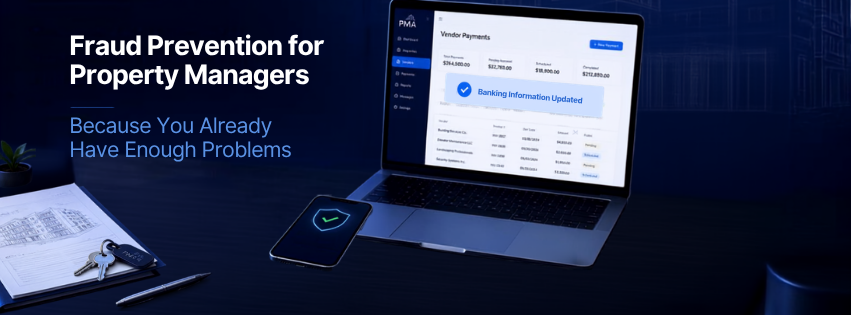
Fraud Prevention for Property Managers: Because You Already Have Enough Problems
As a property manager, your day is rarely boring.
Between coordinating repairs, managing budgets, responding to residents, handling vendor requests, and tracking down that one contractor who promised to send an invoice three weeks ago, there's always something demanding your attention.
Unfortunately, scammers know this.
Whether you manage multifamily communities, office buildings, retail centers, industrial properties, HOAs, or mixed-use developments – or a combination of them - you're responsible for a constant flow of financial activity.
The good news? Reducing risk doesn't require a million dollar cybersecurity budget. In many cases, a few practical habits can go a long way toward protecting your business, your clients, and the properties you manage.
1. Trust, But Verify
One of the most common fraud schemes today involves fake payment instructions.
A vendor appears to send updated banking information, complete with company logos and familiar contact details. The only problem? The account belongs to a scammer.
Before changing payment instructions or processing large transactions, establish a verification process. A quick phone call to a trusted number already on file can often prevent a costly mistake.
It's a lot easier to verify a payment than explain how it ended up in someone else's account.
2. Don't Let One Person Hold All the Keys
Every superhero has a sidekick. Your financial controls should too.
Review who can:
- Initiate payments
- Approve payments
- Access online banking
- Update vendor information
Whenever possible, separate responsibilities so that no single employee controls an entire transaction from start to finish.
Strong internal controls don't signal a lack of trust. They create accountability and help catch problems before they become expensive lessons.
3. Train Employees to Spot Red Flags
Modern fraud isn't always about hacking systems. More often, it's about manipulating people.
Scammers frequently impersonate vendors, contractors, property owners, executives, and even financial institutions. Their messages usually include urgency, pressure, and requests to bypass normal procedures.
Employees should feel comfortable slowing down and asking questions when something seems unusual.
A legitimate request can survive a quick verification. A scam usually cannot.
4. Keep an Eye on the Money
Catching suspicious activity early is far better than discovering it after the money is gone.
Regularly monitor:
- Operating accounts
- Reserve accounts
- ACH activity
- Wire transfers
- Online banking transactions
Technology can help as well. Many financial institutions offer fraud prevention tools such as Positive Pay and ACH Fraud Protection.
Positive Pay helps detect potentially fraudulent checks by comparing checks presented for payment against a list of checks you've issued. If something doesn't match, the item can be flagged for review before payment is made.
ACH Fraud Protection can help identify unauthorized electronic transactions by allowing businesses to establish rules around who can debit or credit their accounts.
These tools won't replace strong internal controls, but they can add another layer of defense against increasingly sophisticated fraud attempts.
5. Have a Plan Before You Need One
Most organizations have a fire evacuation plan.
Few expect a fire.
The same logic applies to fraud.
A fraud response plan should identify:
- Key internal contacts
- Escalation procedures
- Banking contacts
- Documentation requirements
- Reporting procedures
When an issue arises, nobody wants to be figuring out the game plan in real time. A clear response process can save valuable time and reduce confusion during a stressful situation.
Fraud Prevention Is a Team Effort
There is no single solution that eliminates fraud risk. Effective prevention requires a combination of employee awareness, verification procedures, account monitoring, and strong internal controls.
For property managers, protecting financial assets is just as important as protecting physical properties. Scammers are constantly looking for shortcuts, but a culture of vigilance can help keep them from finding one at your organization.
After all, property managers already spend enough time solving unexpected problems. Fraud shouldn't have to become another item on the to do list.
Griffin Oursler
Communications Specialist
CFG Bank - https://www.cfg.bank/
CFG Bank helps property owners and managers simplify the financial side of their business through commercial banking, treasury management, fraud prevention tools, and personalized service. With a relationship-first approach and a commitment to responsive support, CFG works alongside clients to help streamline operations, improve cash flow management, and support portfolio growth.
Sponsored by: